LIMITED OFFER Save $250 per eye on LASIK — schedule your free consultation today → · LIMITED OFFER Save $250 per eye on LASIK — schedule your free consultation today → · LIMITED OFFER Save $250 per eye on LASIK — schedule your free consultation today → · LIMITED OFFER Save $250 per eye on LASIK — schedule your free consultation today → ·

Author: Garrett Rota

  • LASIK Recovery Timeline: What to Expect the First Day, First Week, and Beyond

    By Garrett Rota, D.O. | Wright Eye Center | Colorado Springs, CO

    One of the biggest advantages of LASIK is how quickly most patients recover.

    In fact, many people are surprised by how much their vision improves within the first 24 hours.

    But there’s an important difference between seeing better and being completely healed.

    Although many LASIK patients return to normal daily activities within a day or two, their eyes continue healing for weeks to months afterward.

    At Wright Eye Center, one of the most common questions we hear is:

    “How long will it take before I can get back to my normal life?”

    The answer depends on the activity, your individual healing process, and how your eyes respond to surgery.

    Here’s a realistic look at what most patients can expect.


    LASIK Recovery Timeline at a Glance

    Time After SurgeryWhat to Expect
    First 4–6 hoursBlurry vision, tearing, burning or light sensitivity
    First 24 hoursSignificant visual improvement for many patients
    Days 2–3Many patients return to work and routine activities
    First weekVision continues improving; dryness and fluctuations are common
    Weeks 2–4Increasing visual stability; some activity restrictions remain
    Months 1–3Continued healing, with gradual improvement in dryness and night vision
    Months 3–6Vision generally becomes more stable as healing progresses

    Every patient heals differently, and these are general expectations rather than guarantees.

    The First Few Hours After LASIK

    Immediately after LASIK, your vision will probably be blurry.

    Some patients describe it as looking through a foggy window.

    You may also notice:

    • Burning or stinging
    • Watery eyes
    • A gritty or foreign-body sensation
    • Light sensitivity
    • Mild discomfort

    These symptoms are expected during the early healing period and often improve significantly within several hours.

    My recommendation for most patients is simple: go home, close your eyes, and rest.

    You’ll need someone to drive you home after surgery.

    Avoid rubbing your eyes, even if they feel irritated. Your corneal flap is beginning to heal, and protecting it during this early period is especially important.

    Follow your postoperative instructions and use your prescribed eye drops as directed.

    At Wright Eye Center, the postoperative drops provided as part of your LASIK treatment are included in your surgical care.

    The Morning After LASIK: What Will Your Vision Be Like?

    For many patients, this is the most exciting part of the entire experience.

    You wake up, open your eyes, and realize you can see things that previously required glasses or contacts.

    Most patients notice substantial visual improvement by the next day.

    However, don’t be concerned if your vision isn’t perfectly sharp immediately.

    You might still experience:

    • Mild blurry vision
    • Fluctuating clarity
    • Dryness
    • Halos around lights
    • Glare while driving at night

    These symptoms are often temporary and improve as healing progresses.

    You’ll typically have a postoperative examination within the first day or two so we can evaluate your vision and make sure your eyes are healing appropriately.

    Days 2–3: Getting Back to Your Routine

    One reason LASIK is so popular is that recovery usually doesn’t require taking weeks away from everyday life.

    Many patients can return to desk work, computer use and other normal activities within a day or two.

    However, feeling ready to return to normal activities doesn’t mean every activity is safe immediately.

    Can I Work on a Computer After LASIK?

    Yes, most patients can return to computer use relatively quickly once they’re comfortable.

    However, prolonged screen time can make dry eye symptoms more noticeable.

    When concentrating on a screen, we naturally blink less frequently. This can cause the tear film to become unstable and vision to fluctuate.

    If your eyes begin feeling dry or tired:

    • Take regular breaks.
    • Blink fully and frequently.
    • Use recommended artificial tears.
    • Avoid pushing through significant discomfort.

    You may notice that your vision is sharp in the morning but becomes slightly blurry after several hours at a computer.

    This is often related to dryness rather than a problem with the laser treatment itself, although persistent or worsening blur should be evaluated.

    The First Week: Your Vision Continues to Improve

    During the first week, most patients feel increasingly comfortable.

    Your vision should generally become more consistent, although some fluctuation is still normal.

    Dryness is one of the most common symptoms during this stage.

    This can be especially noticeable here in Colorado Springs, where low humidity, wind and dry indoor air can contribute to eye irritation.

    Even patients who didn’t have significant dry eye symptoms before surgery may notice temporary dryness afterward.

    Following your prescribed drop regimen and using lubricating drops as recommended can make a substantial difference in comfort.

    One important point: just because your eyes feel normal doesn’t mean you should stop following your postoperative instructions.

    Continue your medications and attend your scheduled follow-up appointments.

    Weeks 2–4: Getting Back to Exercise and Outdoor Activities

    This is one of the topics we’re asked about most frequently in Colorado.

    Many of our patients enjoy hiking, skiing, mountain biking, running, golf and other outdoor activities.

    Fortunately, LASIK generally allows a relatively quick return to exercise.

    However, the type of activity matters.

    Light, non-contact exercise may be possible within the first several days if your surgeon clears you.

    Activities involving direct eye trauma, dust, dirty water or significant physical contact require additional precautions and may need to be postponed for several weeks or longer.

    What About Hiking, Skiing and Mountain Biking?

    Hiking and other low-risk activities can often be resumed earlier than sports that involve falls, flying debris or eye injuries.

    For mountain biking and skiing, protective eyewear is especially important.

    Our Colorado climate also presents some unique challenges:

    • Wind can increase dryness.
    • Dust and dirt can irritate healing eyes.
    • Snow reflection and high-altitude sunlight increase UV exposure.
    • Cold, dry air may make the tear film less comfortable.

    We’ll discuss your specific activities and provide individualized recommendations about when it’s safe to return.

    When Can I Swim After LASIK?

    Swimming deserves special attention because pools, lakes, hot tubs and natural bodies of water can introduce microorganisms or irritants into healing eyes.

    Swimming and hot tubs should be avoided during the initial recovery period. Depending on the situation and your surgeon’s recommendations, restrictions may last several weeks or longer.

    For activities like swimming laps, snorkeling or enjoying a Colorado lake, follow your surgeon’s specific clearance instructions rather than assuming your eyes are ready because your vision feels normal.

    Months 1–3: Why Is My Vision Still Fluctuating?

    One of the most common misconceptions about LASIK is that once you can see clearly, healing is finished.

    That’s not quite how it works.

    The cornea continues to heal after the initial improvement in vision.

    During the first several months, some patients notice:

    • Occasional blurry vision
    • Dryness, especially later in the day
    • Glare around headlights
    • Halos around lights
    • Minor changes in visual clarity

    For many patients, these symptoms gradually become less noticeable.

    Not everyone experiences them, and the degree of improvement varies.

    Significant or persistent symptoms should be discussed with your ophthalmologist rather than assumed to be normal.

    When Is LASIK Fully Healed?

    Although patients often return to normal daily activities quickly, visual stability and corneal healing can take several months.

    For some patients, vision continues changing for three to six months.

    That doesn’t mean you’ll have blurry vision for six months. Many patients see very well much earlier.

    It simply means the healing process continues after your initial recovery.

    This is also why we don’t rush into additional treatment if a patient’s vision isn’t exactly where they expected immediately after surgery.

    Sometimes the best approach is to allow the eye additional time to heal and stabilize.

    What If My Vision Isn’t Perfect After LASIK?

    LASIK has excellent outcomes for appropriately selected patients, but no refractive surgery guarantees perfect vision or complete freedom from glasses.

    Some patients may have a small amount of residual prescription after surgery.

    Others experience changes in vision over time.

    If a patient has a meaningful residual prescription and their eyes are otherwise suitable, an enhancement may be an option once healing and refraction have stabilized.

    At Wright Eye Center, we offer enhancement options for eligible patients under our current policy, including coverage during an initial postoperative period and options for eligible patients later in life.

    We’ll explain the details of our current policy before surgery.

    A Surgeon’s Perspective: Fast Recovery Doesn’t Mean Skipping the Details

    One of the reasons I enjoy LASIK is how quickly patients can experience a meaningful improvement in their vision.

    But I also remind patients that the speed of recovery is only one part of a successful outcome.

    Good results start with careful patient selection, accurate preoperative measurements and realistic expectations.

    After surgery, following instructions matters.

    Using your drops, avoiding unnecessary trauma to the eye and attending your follow-up visits are all important parts of the process.

    And while most patients recover quickly, I don’t want anyone assuming that a problem should simply be ignored because they’ve heard LASIK recovery is easy.

    If something doesn’t seem right during recovery, we’d much rather hear from you than have you wait and worry.

    — Garrett Rota, D.O.

    When Should You Call Your Eye Doctor After LASIK?

    Some irritation, blurry vision and fluctuating clarity can be normal during recovery.

    However, certain symptoms should never be ignored.

    Contact your surgeon promptly if you develop:

    • Significant or increasing eye pain
    • Sudden worsening of vision
    • Increasing redness
    • Marked light sensitivity
    • New or worsening symptoms after initially improving

    Sudden severe vision loss, a new curtain over your vision, or new flashes and floaters require urgent eye evaluation.

    Don’t wait for your next scheduled visit if you’re concerned about a possible complication.


    Frequently Asked Questions About LASIK Recovery

    How long should I take off work after LASIK?

    Many patients return to desk work within one or two days. Patients with physically demanding jobs or significant exposure to dust, debris or potential eye injuries may need additional time.

    Can I drive the day after LASIK?

    Many patients can drive the next day, but only if their vision meets legal driving requirements, they feel comfortable and their eye doctor has cleared them. You’ll need someone to drive you home on surgery day.

    When can I exercise after LASIK?

    Light exercise may be possible within a few days after your surgeon clears you. Contact sports, swimming and activities with higher risks of eye trauma generally require a longer recovery period.

    Is blurry vision normal after LASIK?

    Mild blur and fluctuations can occur during healing, especially with dry eyes. Sudden or worsening blurry vision should be evaluated promptly.

    How long does dry eye last after LASIK?

    Some patients experience temporary dryness for weeks or months. Most improve over time, although persistent dry eye symptoms can occur and may require additional treatment.

    When will my LASIK results be final?

    Many patients see well within the first day, but vision can continue stabilizing over several months. Final results depend on your individual healing response.

    Is LASIK recovery faster than PRK?

    Generally, yes. LASIK usually offers faster initial visual recovery and less early postoperative discomfort. PRK requires regrowth of the corneal surface and typically takes longer to recover.


    Considering LASIK in Colorado Springs?

    If you’ve been putting off LASIK because you’re worried about the recovery process, the first step is simply finding out whether you’re a good candidate.

    At Wright Eye Center, we offer complimentary LASIK consultations to help you understand your options, evaluate your preliminary candidacy and answer your questions.

    If you decide to move forward, we’ll complete a more comprehensive evaluation with advanced measurements and testing before planning treatment.

    Not quite ready to schedule?

    Take our free, two-minute LASIK Candidate Quiz:

    Whether LASIK, PRK or another vision correction procedure is the right choice for you, our goal is to help you make an informed decision with confidence.

    Continue Learning

  • What to Expect Before, During and After LASIK

    What to Expect Before, During and After LASIK


    For many patients, deciding they want better vision is easy.

    The part that makes them nervous is everything that comes next.

    What does LASIK actually feel like? How long does it take? Will it hurt? What will I see during surgery? And how quickly will I be able to see afterward?

    Knowing what to expect can make the entire process much less intimidating.

    At Wright Eye Center, LASIK starts well before the day of surgery. We first determine whether LASIK is the right procedure for your eyes, perform detailed measurements to plan your treatment, and make sure you understand what to expect during recovery.

    Here’s what the process generally looks like.


    Step 1: Start With a Complimentary LASIK Consultation

    Before worrying about surgery, the first question is whether you’re actually a good candidate.

    At Wright Eye Center, we start with a complimentary LASIK consultation.

    During this visit, we’ll discuss your prescription, eye health, lifestyle and vision goals and perform preliminary testing to determine whether you appear to be a good candidate for laser vision correction.

    LASIK isn’t right for everyone.

    Depending on your eyes, we may recommend LASIK, PRK, EVO ICL or another option.

    And sometimes the best recommendation is simply not to have surgery.

    The purpose of this first visit is to help you understand your options before committing to the next step.


    Step 2: Your Comprehensive LASIK Evaluation

    If you appear to be a good candidate and decide you’d like to move forward, we’ll schedule a more comprehensive LASIK evaluation.

    This appointment involves significantly more detailed testing and measurements.

    We evaluate factors such as:

    • Your exact prescription
    • Prescription stability
    • Corneal thickness
    • Corneal shape
    • Corneal health
    • Tear film and ocular surface
    • Overall eye health
    • Your visual goals

    Advanced corneal imaging is particularly important.

    Two patients can have almost identical glasses prescriptions but very different corneal measurements. Those differences can affect whether we recommend LASIK, PRK or another procedure.

    Because this evaluation requires specialized testing, technology and physician time, there is a separate evaluation fee.


    What About Contact Lenses Before Your Evaluation?

    Contact lenses can temporarily alter the shape of the cornea.

    Because accurate corneal measurements are essential when planning laser vision correction, you’ll be given instructions about when to discontinue your contact lenses before your evaluation.

    The amount of time may vary depending on the type of contact lenses you wear.

    Following these instructions helps us obtain the most accurate measurements possible.


    Preparing for LASIK Surgery

    Once we’ve confirmed that you’re a good candidate and you’ve decided to proceed, we’ll give you specific instructions for surgery day.

    These may include guidance about:

    • Eye medications
    • Contact lens wear
    • Makeup and facial products
    • Transportation
    • What to bring with you
    • Your postoperative medications and instructions

    You’ll need someone to drive you home after surgery.

    Your postoperative eye drops are included as part of your LASIK care, so you don’t need to worry about adding a separate medication expense to the procedure.


    What Happens During LASIK?

    LASIK itself is surprisingly quick.

    When you enter the laser suite, we’ll get you positioned comfortably and review what’s going to happen.

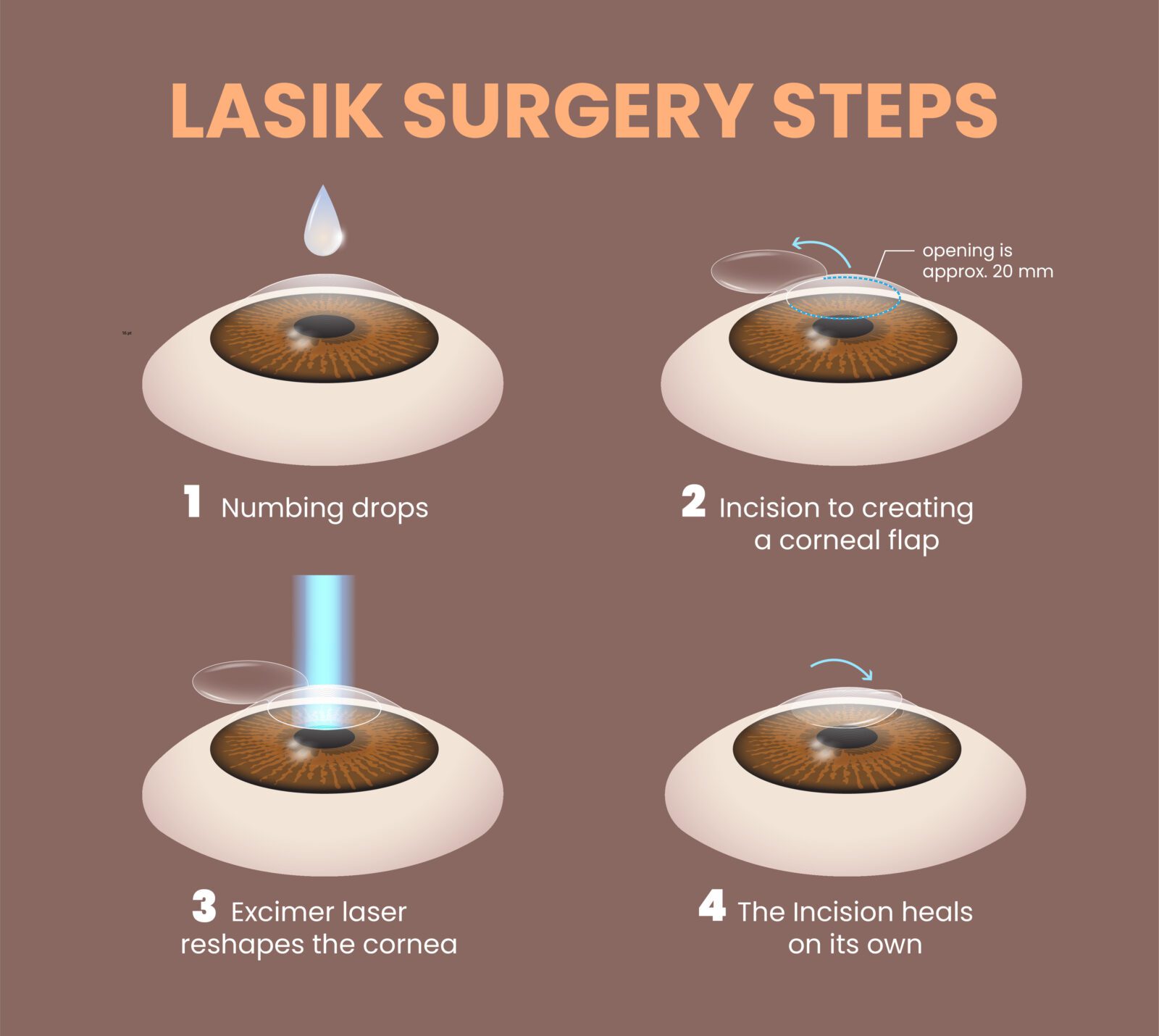
    Numbing eye drops are used, so there are no injections around the eye.

    An instrument gently keeps your eyelids open so you don’t have to worry about blinking.

    One of the most common things patients tell us before surgery is:

    “I’m afraid I’m going to blink or move my eye.”

    You don’t need to worry about either.

    The equipment and surgical process are specifically designed to account for normal eye movement, and we’ll guide you through each step.


    Does LASIK Hurt?

    Most patients describe LASIK as unusual rather than painful.

    You may feel pressure during part of the procedure, but the eye is numbed with anesthetic drops.

    The laser treatment itself usually takes only a short amount of time.

    We’ll talk you through what’s happening throughout the procedure so you know what to expect.


    What Will I See During LASIK?

    You won’t be watching the surgery happen.

    You may notice lights, changes in brightness, blurry vision or other visual sensations during different parts of the procedure.

    At certain moments, your vision may become very dim or temporarily disappear.

    This can sound alarming when you read about it beforehand, but it’s expected and brief.

    Knowing that ahead of time makes it much less surprising when it happens.


    What Happens Immediately After LASIK?

    Your vision will usually be blurry immediately after surgery.

    Many patients describe it as looking through fog or a steamy window.

    Your eyes may also:

    • Water
    • Burn
    • Feel irritated
    • Feel gritty
    • Be sensitive to light

    These symptoms are generally most noticeable during the first several hours.

    For most patients, the best thing to do after getting home is simple:

    Rest your eyes and sleep if you can.

    By the time many patients wake up later that day or the following morning, their vision is already significantly clearer.


    The Morning After LASIK

    This is often the exciting part.

    Many patients wake up the morning after LASIK and can immediately see things they previously couldn’t see without glasses or contacts.

    Vision isn’t necessarily perfect yet.

    You may still notice:

    • Mild blur
    • Fluctuating vision
    • Dryness
    • Halos around lights
    • Glare
    • Light sensitivity

    These symptoms typically improve as the eyes heal.

    We’ll examine your eyes after surgery to make sure everything is healing appropriately.


    When Can I Go Back to Work?

    Many patients return to work relatively quickly after LASIK, depending on their occupation and how their eyes are feeling.

    Someone who works at a computer may return sooner than someone whose job involves dust, debris, physical contact or environments that could expose the eyes to injury.

    We’ll provide recommendations based on your individual situation.


    When Can I Exercise Again?

    One of the most common questions we hear in Colorado is:

    “When can I get back to working out, hiking, skiing or biking?”

    Most patients can return to many normal activities relatively quickly, but certain activities require more caution during the early healing period.

    Swimming, hot tubs, dusty environments and activities with a higher risk of something striking the eye generally require additional precautions.

    We’ll give you specific instructions based on the activities you enjoy.


    What About Dry Eye?

    Temporary dryness is common after LASIK.

    Even patients who didn’t consider themselves to have dry eye before surgery may notice:

    • Burning
    • Grittiness
    • Fluctuating vision
    • Tired eyes
    • Increased awareness of their eyes

    Colorado’s dry climate can make these symptoms more noticeable.

    That’s one reason we evaluate the ocular surface carefully before surgery.

    Treating significant dryness before LASIK and using postoperative drops as directed can help make recovery more comfortable.


    What About Halos and Night Vision?

    Glare, halos and changes in night vision can occur during the early healing period.

    For many patients, these symptoms improve as the eye heals and the visual system adapts.

    We discuss night vision before surgery because expectations matter.

    Our goal isn’t simply to get you through the procedure. We want you to understand both the benefits and the limitations of laser vision correction before you decide to have it.


    How Long Does LASIK Take to Fully Heal?

    LASIK has a remarkably fast initial recovery, but that doesn’t mean the eye is completely healed the next morning.

    Vision may fluctuate during the early recovery period, particularly with dryness or prolonged computer use.

    Your vision generally becomes increasingly stable as healing progresses.

    That’s why postoperative visits remain important even when you’re already seeing well.


    What If My Vision Isn’t Perfect?

    LASIK is extremely precise, but no surgical procedure can guarantee a particular visual result.

    Occasionally, a patient’s final prescription may not be exactly what we intended.

    If enough residual prescription remains to bother you and your eyes are otherwise appropriate for additional treatment, an enhancement may be considered.

    Wright Eye Center maintains an enhancement policy for eligible patients. Because those policies can change over time, we’ll review the current details with you before surgery.


    A Surgeon’s Perspective: The Surgery Is Usually the Easy Part

    One of the things I tell nervous patients is that the anticipation is often harder than the procedure itself.

    LASIK happens quickly, and we’re talking to you throughout the process.

    But the most important part of LASIK isn’t how fast the laser works.

    It’s everything we do before you enter the laser suite.

    Careful patient selection, accurate measurements and choosing the right procedure for the right eye are what allow us to perform refractive surgery confidently.

    Sometimes those measurements tell us LASIK is a great option.

    Sometimes they lead us toward PRK or EVO ICL.

    And occasionally they tell us that surgery isn’t worth the risk.

    That’s exactly what a good refractive surgery evaluation is supposed to accomplish.


    Frequently Asked Questions About LASIK

    Will I be awake during LASIK?

    Yes. LASIK is performed while you’re awake. Numbing drops are used to keep the eyes comfortable, and we’ll guide you through the procedure.

    What if I blink?

    You don’t need to worry about blinking during LASIK. Your eyelids are gently held open during the procedure.

    What if I move my eye?

    Modern laser systems are designed to monitor eye position during treatment. We’ll also guide you where to look throughout the procedure.

    Can I drive myself home?

    No. You should arrange for someone to drive you home after LASIK.

    How soon will I be able to see?

    Most patients notice a significant improvement very quickly, often by the following morning, although vision can fluctuate during healing.

    Are my eye drops included?

    Yes. The postoperative medications used as part of your LASIK care are included.

    How do I know if I’m a candidate?

    Start with a complimentary LASIK consultation. We’ll perform preliminary testing and discuss your vision goals to determine whether LASIK—or another vision correction option—may be appropriate.


    Ready to Find Out if LASIK Is Right for You?

    You don’t have to decide whether you want surgery before coming to see us.

    That’s the purpose of the consultation.

    At Wright Eye Center, your initial LASIK consultation is complimentary. We’ll evaluate whether you appear to be a candidate, discuss your options and answer your questions without requiring you to commit to surgery.

    You can also start from home with our online LASIK and PRK Candidate Quiz:

    Take the Candidate Quiz:
    https://wrighteye.com/am-i-a-canidate-lasik-prk/

    Whether LASIK, PRK, EVO ICL or another option is ultimately right for you, our goal is to help you understand your choices and make the decision that’s best for your eyes.

  • LASIK vs. PRK vs. EVO ICL: Which Vision Correction Option Is Right for You?

    LASIK vs. PRK vs. EVO ICL: Which Vision Correction Option Is Right for You?

    If you want to reduce your dependence on glasses or contact lenses, LASIK may be the first procedure that comes to mind.

    But LASIK isn’t the only option.

    Today, we can choose from several excellent vision correction procedures, including LASIK, PRK, EVO ICL and refractive lens exchange (RLE).

    One of the most common questions we hear at Wright Eye Center is:

    “Which one is best?”

    The answer depends on your eyes.

    Your prescription, corneal shape and thickness, age, lifestyle, eye health and vision goals all play a role. Two patients with similar glasses prescriptions may ultimately be better suited for completely different procedures.

    Here’s how the major options compare.


    LASIK: Fast Recovery and Excellent Vision Correction

    LASIK is the procedure most people associate with laser vision correction.

    During LASIK, a thin flap is created in the cornea. An excimer laser then precisely reshapes the underlying corneal tissue to correct nearsightedness, farsightedness and/or astigmatism. The flap is repositioned at the end of the procedure.

    Why Patients Choose LASIK

    One of LASIK’s biggest advantages is its rapid recovery.

    Many patients notice dramatically improved vision by the next morning and are able to return to many normal activities relatively quickly.

    Other advantages include:

    • Fast visual recovery
    • Minimal discomfort for most patients
    • Treatment of a broad range of prescriptions
    • Excellent visual outcomes in appropriately selected patients
    • Reduced dependence on glasses and contact lenses

    However, LASIK isn’t right for every eye.

    Corneal thickness, corneal shape, dry eye and other factors must be carefully evaluated before recommending surgery.


    PRK: Similar Goal, Different Approach

    PRK uses the same type of excimer laser used in LASIK to reshape the cornea.

    The major difference is how we access the tissue being treated.

    Instead of creating a LASIK flap, the thin surface layer of the cornea—the epithelium—is removed. The laser treatment is then performed directly on the underlying corneal surface.

    The epithelium naturally grows back over the following several days.

    Why Would We Recommend PRK Instead of LASIK?

    Some patients are surprised when we tell them they’re a good candidate for laser vision correction—but that we recommend PRK instead of LASIK.

    There are several reasons this may occur.

    PRK may be preferable for certain patients with:

    • Corneas that aren’t ideal for creating a LASIK flap
    • Certain corneal thickness considerations
    • Particular occupational requirements
    • Lifestyle considerations involving a greater risk of direct eye trauma
    • Previous eye surgery

    The tradeoff is recovery.

    PRK typically involves more discomfort during the first few days and vision takes longer to sharpen compared with LASIK.

    The final goal, however, is very similar: excellent vision with reduced dependence on glasses or contact lenses.


    LASIK vs. PRK: What’s the Biggest Difference?

    For most patients, the biggest practical difference is recovery.

    LASIK patients often see quite well very quickly.

    PRK patients need more patience.

    The surface of the cornea must heal, and vision can fluctuate as that process occurs. It may take several weeks or longer for vision to reach its final level of clarity.

    That doesn’t make PRK an inferior procedure.

    For the right patient, PRK may actually be the better choice.

    We would rather recommend a slightly slower recovery if we believe it provides the better option for that patient’s individual eyes.


    EVO ICL: Vision Correction Without Removing Corneal Tissue

    EVO ICL takes a completely different approach.

    Rather than reshaping the cornea with a laser, a thin implantable lens is placed inside the eye, behind the iris and in front of your natural lens.

    Think of it somewhat like placing a permanent contact lens inside the eye rather than wearing one on the surface.

    Who Might Benefit From EVO ICL?

    EVO ICL can be an excellent option for patients with moderate to high levels of nearsightedness, particularly when laser vision correction isn’t ideal.

    Potential advantages include:

    • No removal of corneal tissue
    • Excellent quality of vision
    • Treatment of higher levels of nearsightedness
    • Correction of astigmatism with toric models when appropriate
    • The lens can be removed if necessary

    For some patients who have spent years assuming their prescription is “too high for LASIK,” EVO ICL may open an entirely different path toward reducing dependence on glasses or contacts.


    EVO ICL vs. LASIK

    Neither procedure is universally better.

    LASIK reshapes the cornea.

    EVO ICL leaves the central corneal tissue intact and instead adds a corrective lens inside the eye.

    That difference can make EVO ICL particularly attractive for certain highly nearsighted patients or patients whose corneal measurements make laser vision correction less desirable.

    However, EVO ICL is an intraocular procedure, meaning surgery takes place inside the eye. It therefore has a different set of considerations and risks than LASIK or PRK.

    The right recommendation comes from weighing those differences against the characteristics of your individual eyes.


    What About Refractive Lens Exchange?

    For some patients—particularly as they get older—LASIK, PRK and EVO ICL aren’t the only procedures worth discussing.

    Refractive lens exchange (RLE) replaces the eye’s natural lens with an artificial intraocular lens, similar to what we do during cataract surgery.

    RLE can correct distance vision while also addressing the age-related loss of near focusing ability known as presbyopia.

    Different lens implants can provide different ranges of vision depending on the patient’s eyes and goals.

    RLE isn’t the right procedure for every patient, and age alone doesn’t determine whether someone should have it. Your prescription, retinal health, natural lens, lifestyle and visual goals all need to be considered.


    What About Patients Over 40?

    Turning 40 doesn’t automatically make you too old for LASIK.

    But something important begins happening around this age.

    The natural lens inside the eye gradually loses its ability to focus up close. This is called presbyopia, and it’s why many people eventually need reading glasses.

    LASIK can correct your distance prescription, but it doesn’t stop the natural aging process of the lens.

    That’s why our conversation with a 25-year-old considering LASIK may be very different from our conversation with a 48-year-old.

    Depending on the patient, options may include LASIK, monovision, PRK, EVO ICL, RLE or simply waiting.

    Understanding what you want your vision to accomplish—both now and years from now—is an important part of choosing the right procedure.


    How Do We Decide Which Procedure Is Right for You?

    This is where a refractive surgery evaluation becomes important.

    We don’t choose a procedure based on your glasses prescription alone.

    We consider factors including:

    • Your prescription
    • Prescription stability
    • Corneal thickness
    • Corneal shape and health
    • Dry eye
    • Age
    • Natural lens changes
    • Retinal health
    • Your occupation
    • Sports and hobbies
    • Your expectations
    • Your distance and near vision goals

    Advanced imaging can also reveal subtle findings that aren’t apparent during a routine eye examination.

    Sometimes the answer is straightforward.

    Other times, a patient may be a candidate for more than one procedure. In those situations, we’ll explain the advantages and tradeoffs of each option and help you decide which best fits your priorities.


    A Surgeon’s Perspective: The Best Procedure Isn’t Always LASIK

    Patients sometimes come into our office saying, “I want LASIK.”

    That’s completely understandable. LASIK is by far the most recognized name in vision correction.

    But our job isn’t simply to determine whether we can perform LASIK.

    Our job is to determine what we should recommend.

    If your corneal measurements make us more comfortable with PRK, we’ll tell you.

    If you have a high prescription and we believe EVO ICL offers a better option, we’ll discuss that.

    And if we don’t believe refractive surgery is appropriate for your eyes, we’ll tell you that too.

    The best vision correction procedure isn’t the newest procedure or the most recognizable one.

    It’s the one that makes the most sense for your individual eyes.


    Frequently Asked Questions

    Is PRK better than LASIK?

    Neither procedure is inherently better. LASIK offers faster recovery, while PRK may be preferable for certain corneas, occupations or lifestyles. The better procedure depends on the individual patient.

    Does PRK give the same vision as LASIK?

    Both procedures use an excimer laser to reshape the cornea and can provide excellent visual outcomes in appropriately selected patients. PRK simply requires a longer healing process.

    Is EVO ICL better than LASIK for high prescriptions?

    EVO ICL can be an excellent option for patients with higher levels of nearsightedness. Whether it’s preferable to LASIK depends on the prescription, corneal measurements and other characteristics of the eye.

    Can I have LASIK after age 40?

    Yes. Many patients over 40 can still be candidates for LASIK. However, presbyopia and changes in the natural lens become increasingly important when determining the best vision correction strategy.

    What if I’m not a candidate for any of these procedures?

    Sometimes surgery isn’t the right choice. If we don’t believe a procedure can provide an appropriate balance of safety and benefit, we’ll recommend continuing with glasses or contact lenses rather than performing surgery simply because it’s possible.


    Which Vision Correction Procedure Is Right for You?

    You don’t need to figure that out on your own.

    That’s what your evaluation is for.

    At Wright Eye Center, we offer a complimentary vision correction consultation to determine whether you may be a candidate and discuss which options make the most sense for your eyes.

    If you’d rather start online, you can also take our LASIK and PRK Candidate Quiz:

    Take the Candidate Quiz:
    https://wrighteye.com/am-i-a-canidate-lasik-prk/

    Whether the answer is LASIK, PRK, EVO ICL, RLE—or no surgery at all—our goal is to help you understand your options and make a decision you’re comfortable with.


  • The Wright Eye Center LASIK Process

    The Wright Eye Center LASIK Process

    Our goal is to make sure LASIK is the right choice before recommending surgery.

    Step 1: Complimentary LASIK Consultation

    Your journey begins with a complimentary LASIK consultation.

    During this visit, we’ll:

    • Discuss your vision goals 
    • Review your medical and eye history 
    • Perform preliminary testing 
    • Answer your questions 
    • Determine whether you’re likely to be a good candidate for LASIK or another vision correction procedure 

    Many patients leave this visit with a clear understanding of their options and whether they want to move forward.


    Step 2: Comprehensive LASIK Evaluation

    If you decide to proceed, the next step is a comprehensive LASIK evaluation.

    This visit includes advanced diagnostic testing and detailed measurements that allow us to confirm whether LASIK is safe for your eyes and to customize your treatment.

    Because this evaluation involves specialized technology, extensive testing, and dedicated physician time, there is a separate fee for this portion of the process.

    Our philosophy is simple: we don’t believe every patient should automatically move on to advanced testing. We first want to make sure LASIK appears to be a good fit and that you’re comfortable moving forward.


    Step 3: Surgery and Follow-Up Care

    If LASIK is the right option for you, your procedure includes:

    • Personalized treatment planning 
    • Your LASIK procedure 
    • Postoperative medications 
    • Scheduled follow-up visits to monitor healing 

    We also stand behind our results. While enhancement policies may change over time, eligible patients who need additional treatment may qualify for enhancement options under our current policy. We’ll review those details with you during your consultation so you know exactly what to expect.


    Looking Beyond the Price Tag

    When researching LASIK, it’s easy to compare numbers online.

    But choosing LASIK isn’t like shopping for a television or a new phone.

    You’re trusting someone with one of your most important senses—your vision.

    Rather than asking, “Who is the cheapest?” consider asking:

    • Do I feel confident in this surgeon? 
    • Do I understand my options? 
    • Has enough testing been performed to know LASIK is safe for my eyes? 
    • Will I receive personalized recommendations? 
    • What kind of care will I receive after surgery? 

    Those answers often matter far more than a difference in price.


    The Long-Term Cost of Glasses and Contact Lenses

    Many patients compare LASIK to the cost of buying a new pair of glasses.

    A better comparison is the total amount spent on vision correction over many years.

    Depending on your prescription and lifestyle, those costs may include:

    • New glasses every few years 
    • Backup glasses 
    • Prescription sunglasses 
    • Contact lenses 
    • Contact lens solution 
    • Routine contact lens examinations 
    • New frames as prescriptions change 
    • Replacement lenses after scratches or damage 
    • Replacing glasses that are lost or broken 

    Over time, these recurring expenses can add up to thousands of dollars.

    LASIK is an upfront investment, but many patients appreciate reducing—or even eliminating—many of these ongoing costs.


    The Benefits Go Beyond Money

    When we ask patients about their favorite part of LASIK, very few start by talking about cost.

    Instead, they mention everyday moments.

    Waking up and seeing the alarm clock without reaching for glasses.

    Taking a camping trip without packing contact lens supplies.

    Swimming with their children without worrying about losing a contact lens.

    Putting on ski goggles without glasses fogging up.

    Traveling with one less thing to remember.

    Playing sports without contacts drying out.

    These small moments happen every day—and for many patients, they’re the greatest value LASIK provides.


    Can You Use an HSA or FSA?

    In many cases, yes.

    LASIK is generally an eligible expense for Health Savings Accounts (HSA) and Flexible Spending Accounts (FSA), allowing many patients to use pre-tax dollars toward their procedure.

    Because every plan is different, we recommend checking with your plan administrator for details about your individual benefits.


    Is LASIK Worth It?

    Only you can decide whether LASIK is worth the investment.

    For many patients, the answer isn’t based solely on dollars saved over time.

    It’s about convenience.

    Freedom.

    Confidence.

    Seeing clearly from the moment you wake up.

    Enjoying Colorado’s outdoors without glasses slipping down your nose or contact lenses drying out in the wind.

    Those benefits are difficult to put a price on.


    Frequently Asked Questions

    Is LASIK covered by insurance?

    Most insurance plans consider LASIK an elective procedure and do not provide coverage. However, many patients are able to use HSA or FSA funds toward treatment.


    Can I use my HSA or FSA?

    In many cases, yes. Check with your benefits administrator to confirm your eligibility.


    Do you offer a free consultation?

    Yes. The Wright Eye Center offers a complimentary LASIK consultation so you can learn whether you’re a candidate before deciding whether to move forward with a comprehensive evaluation.


    What happens if I need an enhancement later?

    While enhancement policies may change over time, eligible patients may qualify for additional treatment under our current policy. We’ll explain the details during your consultation so you understand your options before surgery.


    How do I know if I’m a candidate?

    The best place to start is our complimentary LASIK consultation. If you’d like an initial assessment before scheduling, you can also complete our online LASIK Candidate Quiz.


    Ready to Take the First Step?

    If you’ve been thinking about LASIK, we’d love to help you determine whether it’s the right option for your eyes.

    Your journey begins with a complimentary LASIK consultation, where we’ll discuss your goals, answer your questions, and determine whether LASIK, PRK, EVO ICL, or another vision correction option is the best fit for you.

    If you’re not ready to schedule just yet, you can also take our online LASIK Candidate Quiz for a quick first look at your options.

    At Wright Eye Center, our goal isn’t simply to perform LASIK—it’s to help you make the best decision for your long-term vision.

  • Am I a Good Candidate for LASIK? 7 Things We Evaluate Before Recommending Surgery

    Am I a Good Candidate for LASIK? 7 Things We Evaluate Before Recommending Surgery


    Am I a Good Candidate for LASIK? | Wright Eye Center

    Wondering if you’re a good candidate for LASIK? Learn the seven factors we evaluate and take
    our free online LASIK candidate quiz.

    Am I a Good Candidate for LASIK?

    If you’ve been thinking about LASIK, you’ve probably asked yourself one question:

    “Am I actually a good candidate?”

    The truth is, the only way to know for sure is through a comprehensive evaluation. While many people are excellent candidates for LASIK, others may achieve better results with PRK, EVO ICL, refractive lens exchange (RLE), or even by waiting until the timing is right. At Wright Eye Center, our goal isn’t to recommend LASIK for everyone—it’s to recommend the procedure that’s safest and most likely to provide the best long-term vision for your eyes. This article explains exactly what we look for during every LASIK evaluation.

    Wondering If You’re a Candidate?


    Before scheduling an appointment, you can take our free online LASIK Candidate Quiz. It
    takes just a few minutes and can help determine whether LASIK, PRK, EVO ICL, or another
    option may be right for you.

    👉 Take the LASIK Candidate Quiz

    If your results suggest you’re a good candidate, the next step is a complimentary LASIK
    screening with our team.

    1. Is Your Prescription Stable?

      One of the first things we evaluate is whether your prescription has been stable. LASIK permanently reshapes your cornea to correct your current prescription. If your eyes are
      still changing, your vision may continue to change after surgery. In general, we like to see:


      ● A stable prescription for at least one year
      ● Healthy vision without rapid fluctuations
      ● A prescription within the range LASIK can safely treat


      If your prescription has changed recently, that doesn’t necessarily mean you’ll never qualify—it
      may simply mean waiting a little longer.

    2. Is Your Cornea Healthy?

      This is arguably the most important part of determining LASIK candidacy.

      Your cornea is the clear front window of your eye. During LASIK, we reshape this tissue with an
      excimer laser.


      At Wright Eye Center, every LASIK evaluation includes detailed corneal imaging that measures:

      ● Corneal thickness
      ● Corneal curvature
      ● Corneal shape
      ● Signs of early corneal weakness
      ● Overall corneal health


      Some patients have completely normal vision and an excellent glasses prescription but still
      aren’t safe LASIK candidates because of subtle corneal abnormalities. These issues usually cannot be detected during a routine eye exam. Patient safety always comes first.

    3. Are Your Eyes Otherwise Healthy?

      LASIK treats refractive error—it doesn’t treat every eye disease. We’ll carefully evaluate your eyes for conditions such as:

      ● Cataracts
      ● Glaucoma
      ● Macular degeneration
      ● Corneal disease
      ● Retinal problems
      ● Keratoconus
      ● Significant dry eye


      Sometimes another eye condition should be treated before considering refractive surgery.
    4. How Healthy Is Your Tear Film?

      Dry eye is one of the most overlooked parts of a LASIK evaluation. Many people living in Colorado already have mild dry eye because of our:

      ● Low humidity
      ● High altitude
      ● Wind
      ● Year-round sunshine


      LASIK can temporarily worsen dryness while your eyes heal.

      If significant dry eye is present, we’ll often recommend improving the ocular surface before
      surgery. Doing so can improve:


      ● Comfort
      ● Healing
      ● Vision quality
      ● Measurement accuracy
      ● Long-term satisfaction


      Treating dry eye first often leads to a better overall LASIK experience.
    5. Age Matters—But Not the Way Most People Think

      Many patients ask if they’re too young or too old for LASIK. Age alone rarely determines candidacy. Instead, we consider:

      ● Prescription stability
      ● Your need for reading glasses
      ● Lens changes inside the eye
      ● Your visual goals
      ● Overall eye health


      Patients over 40 are often still excellent candidates for LASIK, although some may benefit more
      from another vision correction procedure depending on their goals.

    6. Your Lifestyle Helps Determine the Best Procedure

      Choosing the right vision correction procedure isn’t just about your prescription.
      We also want to know how you use your eyes every day. Some examples include:


      ● Skiing
      ● Snowboarding
      ● Mountain biking
      ● Hiking
      ● Golf
      ● Running
      ● Swimming
      ● Law enforcement
      ● Military service
      ● Healthcare
      ● Computer work


      A patient who spends every weekend skiing in the Colorado mountains may have different visual priorities than someone who spends most of the day working at a computer.

      Our recommendations are personalized to your lifestyle—not just your prescription.

    7. Sometimes the Best Recommendation Is Not LASIK

      This surprises many patients.

      Not everyone who wants LASIK should have LASIK.

      Sometimes we recommend:


      ● PRK
      ● EVO ICL
      ● Refractive Lens Exchange (RLE)
      ● Waiting until your prescription stabilizes
      ● No surgery at all


      Our philosophy is simple:

      We recommend the procedure we’d feel comfortable recommending to our own family members.

      If LASIK isn’t the safest option, we’ll explain why and discuss alternatives that may better fit your
      eyes and your goals.

    What Happens During a LASIK Evaluation?

    Your consultation is designed to answer one important question:

    What’s the safest and best way to reduce your dependence on glasses or contact lenses?

    Your visit includes:

    ● Comprehensive eye examination
    ● Vision testing
    ● Corneal imaging
    ● Measurement of your prescription
    ● Tear film evaluation
    ● Discussion of your lifestyle and goals
    ● Personalized treatment recommendations


    By the end of your visit, you’ll understand:

    ● Whether you’re a LASIK candidate
    ● If another procedure is a better fit
    ● What results you can realistically expect
    ● The next steps if you decide to move forward

    Frequently Asked Questions

    How do I know if I’m a good candidate for LASIK?

    The best way to find out is through a comprehensive evaluation. Factors such as your
    prescription, corneal health, tear film, age, and overall eye health all play a role.

    Does wearing contact lenses affect LASIK?

    Yes. Contact lenses can temporarily change the shape of your cornea, which is why we’ll ask
    you to stop wearing them before your evaluation for a specific period of time depending on the
    type of lenses you wear.

    Can LASIK correct astigmatism?

    Yes. LASIK commonly treats both nearsightedness and astigmatism, provided your eyes are
    healthy and your prescription falls within safe treatment ranges.

    What if I’m not a LASIK candidate?

    Many patients who aren’t ideal LASIK candidates are excellent candidates for PRK, EVO ICL, or
    refractive lens exchange. We’ll explain all of your options.

    Is the evaluation free?

    Wright Eye Center offers a complimentary LASIK screening to help determine whether you’re
    a candidate before moving forward with additional testing.

    Take Our Free LASIK Candidate Quiz

    Not quite ready to schedule a visit?

    Our online LASIK Candidate Quiz takes just a few minutes to complete and can help you
    understand whether LASIK or another vision correction procedure may be right for you.


    👉 Take the Quiz

    Ready to Learn More?

    Every patient—and every eye—is different. That’s why there isn’t a one-size-fits-all answer to
    whether LASIK is right for you.


    At Wright Eye Center, we’ll take the time to understand your vision, evaluate your eye health
    using advanced diagnostic technology, and recommend the treatment that offers the safest path
    to your best possible vision.

    Whether that’s LASIK, PRK, EVO ICL, or another option, our goal is simple: to help you make
    an informed decision with confidence.

    Take our free online LASIK Candidate Quiz or schedule your complimentary LASIK
    screening to get started.

  • Understanding Cataracts: Why Vision Changes as We Age

    Understanding Cataracts: Why Vision Changes as We Age

    By: Dr. Garrett Rota

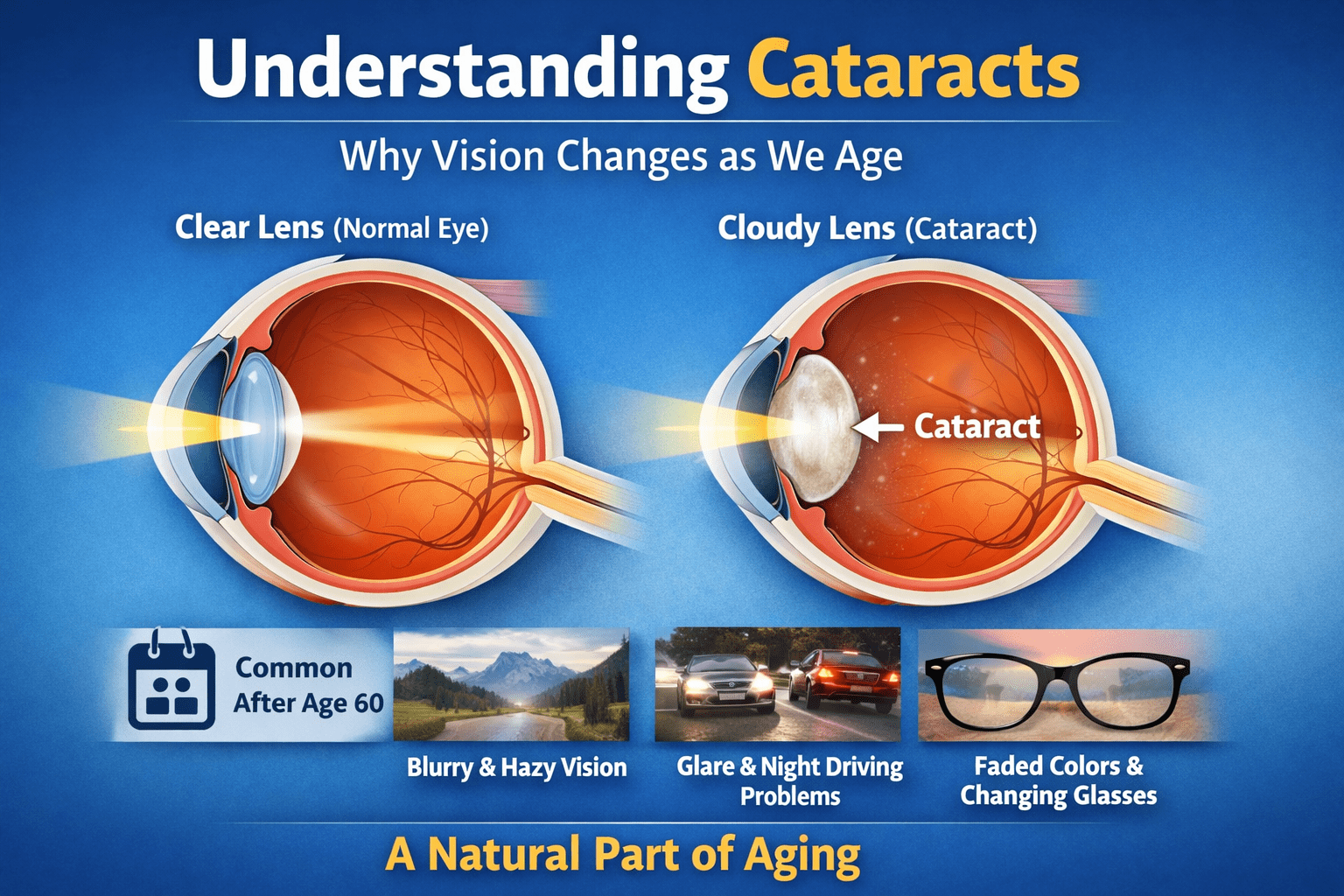
    If your vision has become blurry or you’re having more trouble with glare, you may have been told you have a cataract. Cataracts are extremely common, especially after age 60.

    What Is a Cataract?

    Inside your eye is a natural lens. When we are young, that lens is clear. As we age, the lens slowly becomes cloudy. This cloudiness is called a cataract.

    It is not a film over the eye. It is not caused by overusing your eyes. It is a normal part of aging.

    By age 70, most people have some degree of cataract.

    What Causes Cataracts?

    The most common cause is simply aging. Other factors can include:

    • Diabetes
    • Long-term steroid use
    • Previous eye injury
    • Excess sun exposure
    • Smoking

    But for most patients, cataracts develop naturally over time.

    What Symptoms Do Cataracts Cause?

    Cataracts usually develop slowly. You may notice:

    • Blurry or hazy vision
    • Difficulty driving at night
    • Glare or halos around headlights
    • Colors appearing faded or yellowed
    • Needing brighter light to read
    • Frequent changes in glasses

    Many patients say, “It feels like I’m looking through a foggy window.”

    Do Cataracts Need to Be Removed Right Away?

    Not necessarily.

    Cataracts only need to be treated when they begin interfering with your daily life. If you are still functioning comfortably, we simply monitor them during routine eye exams.

    When they begin affecting activities like driving, reading, or enjoying hobbies, surgery may be recommended.

    The good news: cataracts are treatable, and vision can often be restored very successfully.

Review on Google Review on Facebook
Love your results? Leave us a review ⭐